Home Publications People Schedule Projects Teaching Join Us
Genetic analyses of the roles of peroxisomes and the
auxin precursor indole-3-butyric acid (IBA) in Arabidopsis

Bonnie Bartel, Professor
Department of Biochemistry and Cell Biology
bartel@rice.edu

We are using molecular genetic approaches to elucidate functions of indole-3-butyric acid (IBA) in Arabidopsis.  Although IBA is a naturally occurring form of the plant growth hormone auxin and is used commercially to promote rooting in many species, the molecular mechanisms by which it acts are only beginning to be understood.

Our finding that conversion of IBA to the active auxin indole-3-acetic acid (IAA) occurs in peroxisomes motivated our study of the biogenesis, function, and dynamics this vital organelle.  Peroxisomes compartmentalize certain metabolic reactions, thereby protecting the cytosol from oxidative damage.  We employ IBA-response screens to isolate mutants defective in enzymes catalyzing IBA-to-IAA conversion and mutants defective in biogenesis of peroxisomes, which house these enzymes.  Our analysis of these mutants has revealed new matrix protein import components, unanticipated interdependencies among peroxisome biogenesis factors, and a novel pathway for degrading peroxisome matrix proteins during developmentally controlled organelle remodeling.  We have uncovered multiple intriguing examples in which Arabidopsis peroxisomes more closely resemble mammalian peroxisomes than do yeast or nematode peroxisomes, suggesting that our studies can provide unique insights into human peroxisome biogenesis disorders.

To understand auxin action, the functional significance of the endogenous auxins must be determined.  Identifying genes involved in converting IBA to IAA is a prerequisite to understanding the regulation and importance of this conversion.  This knowledge is essential to determine the contributions of IBA relative to other inputs to the active auxin pool, including de novo synthesis and conjugate hydrolysis.  Moreover, elucidating the molecular mechanisms of IBA action in a genetically tractable plant may provide insights for agricultural IBA uses. 

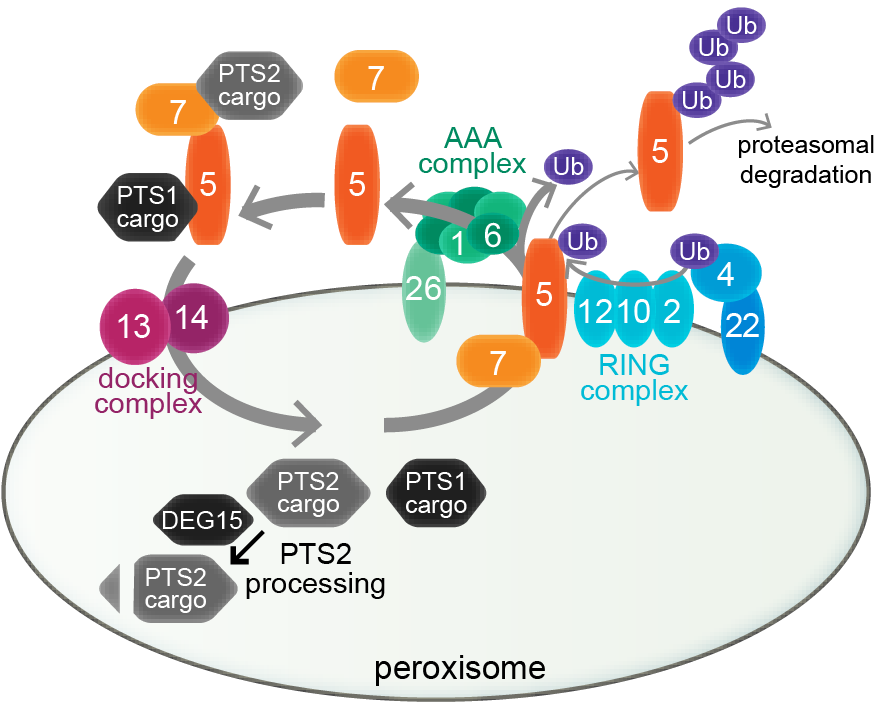
Peroxisome biogenesis and function.  Peroxisome biogenesis requires a core set of conserved peroxins (numbered ovals) to recruit peroxisomal membrane proteins (PMPs) to the ER and form pre-peroxisomes (A) and to import matrix proteins (B), which are synthesized in the cytosol and targeted to the peroxisome via PEX5 interaction with a C-terminal PTS1 (black proteins) or PEX7 interaction with an N-terminal PTS2 (gray proteins).  PEX5 docks with a PEX14-13 complex for cargo delivery; PEX7 binding to PEX5 (in plants and mammals) is required for PTS2-protein delivery.  Receptor-recycling peroxins remove PEX5 via mono-ubiquitination by the PEX4 Ub-conjugating enzyme and the PEX12 ring-finger peroxin, allowing removal by PEX1 and PEX6 ATPases.  The details of PEX7 recycling are unknown.  The LON2 protease contributes to sustained matrix protein import, perhaps degrading free PTS2 peptide or otherwise aiding in receptor-cargo or receptor-receptor dissociation.  Other matrix proteins clip the PTS2 signal (DEG15), beta-oxidize fatty acids or IBA (IBR proteins, ECH2, PED1), and carry out other peroxisomal processes.  PXA1 is an ABC transporter likely importing both fatty acids and IBA.  During seeding development, fatty acid beat-oxidation provides energy and IBA-derived IAA (auxin) drives multiple processes.  We have characterized mutants defective in proteins outlined in blue.


Lab members with IBA/peroxisome projects:

Post Docs:
Lisa Farmer
Sarah Ratzel

Graduate Students:
Sarah Christensen
Wendell Fleming

Kim Gonzalez
Yun-Ting Kao
Mauro Rinaldi

Technician:
Adrianne Stone

Undergraduates:
Ja Young Choi
Lynn Pauls
Savina Venkova
Meredith Ventura

Collaborator:
Andrew Woodward

Former Grad Students and Post Docs:
A. Raquel Adham (Ph.D., '05)
Matthew Lingard (postdoc)
Melanie Monroe-Augustus (Ph.D., '04)
Elizabeth Poggio (M.A., '08)
Sarah Ratzel (Ph.D., '11)
Jerrad Stoddard (M.A., '12)
Lucia Strader (postdoc)
Andrew Woodward (Ph.D., '05)
Bethany Zolman
(Ph.D., '02)


We gratefully acknowledge support for this research from the NIH (5R01GM079177), the NSF (IBN-0315596; MCB-0745122), the Robert A. Welch Foundation, predoctoral NIH fellowships (ARA and NM), a NIH training grant (T32-GM08362; MMA and JR), and Houston Livestock Show and Rodeo scholarships (ARA, AWW, EP, SR, MMA).

Publications on IBA and peroxisomes:

Other Bartel lab projects:
Auxin signaling, conjugates, peroxisomes


Matrix proteins are inefficiently imported into Arabidopsis peroxisomes lacking the receptor-docking peroxin PEX14.
Monroe-Augustus, M., Ramón, N.M., Ratzel, S.E., Lingard, M.J., Christensen, S.E., Murali, C., and Bartel, B. (2011) Plant Molecular Biology 77, 1-15. (featured on the cover)
Abstract; full text; PDF

Multiple facets of Arabidopsis seedling development require indole-3-butyric acid-derived auxin.
Strader, L.C., Wheeler, D.L., Christensen, S.E., Berens, J., Cohen, J.D., Rampey, R.A., and Bartel, B. (2011) The Plant Cell 23, 984-999.
Abstract; full text; PDF

Transport and metabolism of the endogenous auxin precursor indole-3-butyric acid.
Strader, L.C. and Bartel, B. (2011) Molecular Plant 4, 477-498. doi: 10.1093/mp/ssr006 (Review Article)
Abstract; full text; PDF

Reducing PEX13 expression ameliorates physiological defects of late-acting peroxin mutants.
Ratzel, S.E., Lingard, M.J., Woodward, A.W., and Bartel, B. (2011) Traffic 12, 121-134.
Abstract; full text; PDF

Conversion of endogenous indole-3-butyric acid to indole-3-acetic acid drives cell expansion in Arabidopsis thaliana seedlings.
Strader, L.C., Culler, A.H., Cohen, J.D., and Bartel, B. (2010) Plant Physiology 153, 1577-1586.
Abstract; full text; PDF

Interdependence of peroxisome-targeting receptors in Arabidopsis thaliana: PEX7 facilitates PEX5 accumulation and import of PTS1 cargo into peroxisomes.
Ramon, N.M. and Bartel, B. (2010) Molecular Biology of the Cell 21, 1263-1271.
Abstract; full text; PDF

Arabidopsis PIS1 encodes the ABCG37 transporter of auxinic compounds including the auxin precursor indole-3-butyric acid.
Ruzicka, K., Strader, L.C., Bailly, A., Yang, H., Blakeslee, J., Langowski, L., Nejedla, E., Fujita, H., Itoh, H., Syono, K., Hejatko, J., Gray, W.M., Martinoia, E., Geisler, M., Bartel, B., Murphy, A.S., and Friml, J. (2010) Proc. Natl. Acad. Sci. USA 107, 10749-10753.
Abstract; full text; PDF

Arabidopsis LON2 is necessary for peroxisomal function and sustained matrix protein import.
Lingard, M.J. and Bartel, B. (2009) Plant Physiology 151, 1354-1365.
Abstract; full text; PDF

Peroxisome-associated matrix protein degradation in Arabidopsis
Lingard, M.J., Monroe-Augustus, M., and Bartel, B. (2009) Proc. Natl. Acad. Sci. USA 106:4561-4566.
Abstract; full text; PDF

Disruption of Arabidopsis CHY1 reveals an important role of metabolic status in plant cold stress signaling.
Dong, C.-H., Zolman, B.K., Bartel, B., Lee, B.-h., Stevenson, B., Agarwal, M., and Zhu, J.-K. (2009) Molecular Plant 2, 59-72.
Abstract; full text; PDF

Arabidopsis iba response5 (ibr5) suppressors separate responses to various hormones.
Strader, L.C., Monroe-Augustus, M., Rogers, K.C., Lin, G.L., and Bartel, B. (2008) Genetics180, 2019-2031.
Abstract; full text; PDF

Identification and characterization of Arabidopsis indole-3-butyric acid response mutants defective in novel peroxisomal enzymes.
Zolman, B.K., Martinez, N., Millius, A., Adham, A.R., and Bartel, B. (2008) Genetics 180, 237-251.
Abstract; full text; PDF

IBR3, a novel peroxisomal acyl-CoA dehydrogenase-like protein required for indole-3-butyric acid response. 
Zolman, B.K., Nyberg, M., and Bartel, B. (2007) Plant Molecular Biology 64, 59-72.
Abstract; full text; PDF

Identification and functional characterization of Arabidopsis PEROXIN4 and the interacting protein PEROXIN22.
Zolman, B.K., Monroe-Augustus, M., Silva, I.D., and Bartel, B. (2005) Plant Cell 17, 3422-3435.
Abstract; full text

Auxin: regulation, action, and interaction. 
Woodward, A.W. and Bartel, B. (2005) Annals of Botany,95, 707-735.
Abstract; full text

Mutations in Arabidopsis thaliana acyl-CoA oxidase genes reveal overlapping and distinct roles in b-oxidation. 
Adham, A.R., Zolman, B.K., Millius, A., and Bartel, B. (2005) The Plant Journal 41, 859-874.
Abstract; full text

The Arabidopsis peroxisomal targeting signal type 2 receptor PEX7 is necessary for peroxisome function and dependent on PEX5.
Woodward, A.W. and Bartel, B. (2005) Molecular Biology of the Cell 16, 573-583.
Abstract; full text

An Arabidopsis indole-3-butyric acid-response mutant defective in PEROXIN6, an apparent ATPase implicated in peroxisomal function. 
Zolman, B.K. and Bartel, B. (2004) Proc. Natl. Acad. Sci. USA 101, 1786-1791.

Abstract; PDF

The Arabidopsis pxa1 mutant is defective in  an ATP-binding cassette transporter-like protein required for peroxisomal fatty acid b-oxidation. 
Zolman, B.K., Silva, I.D., and Bartel, B. (2001) Plant Physiology 127, 595-604. 
(On the cover)
Abstract; full text; PDF

chy1, an Arabidopsis mutant with impaired b-oxidation, is defective in a peroxisomal b-hydroxyisobutyryl-CoA hydrolase.
Zolman, B.K., Monroe-Augustus, M., Thompson, B., Hawes, J.W., Krukenberg, K.A., Matsuda, S.P.T., and Bartel, B. (2001) Journal of Biological Chemistry 276, 31037-31046.

Abstract; full text; PDF

Inputs to the active indole-3-acetic acid pool: de novo synthesis, conjugate hydrolysis, and indole-3-butyric acid b-oxidation.
Bartel, B., LeClere, S., Magidin, M., and Zolman, B.K. (2001) Journal of Plant Growth Regulation 20, 198-216.  (Review Article)

Abstract; full text

Genetic analysis of indole-3-butyric acid responses in Arabidopsis thaliana reveals four mutant classes. 
Zolman, B.K, Yoder, A., and Bartel, B.  (2000) Genetics 156, 1323-1337. 

Abstract; full text; PDF


Biochemistry